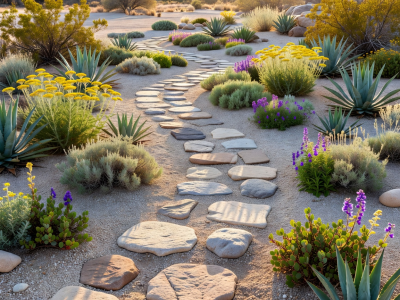
Blurring the Boundary Between Architecture and Nature
Sustainable home design does not stop at the exterior walls; the surrounding landscape is an integral extension of the home’s ecological footprint. Traditional suburban landscaping, often dominated by resource-intensive turf grass lawns, requires excessive water, chemical fertilizers, and fossil-fuel-powered maintenance. Eco-friendly landscaping reimagines the yard as a functional, low-impact, and biodiverse habitat.
Native and Drought-Tolerant Planting (Xeriscaping)
The foundation of an eco-friendly landscape is the selection of native plant species. Plants that are indigenous to a region have evolved over millennia to thrive in the local climate, soil conditions, and rainfall patterns. Consequently, once established, they require little to no supplemental watering, no synthetic fertilizers, and exhibit natural resistance to local pests.
In arid climates, this concept expands into xeriscaping—a design philosophy centered entirely on water conservation. Xeriscaping replaces thirsty lawns with striking arrays of succulents, ornamental grasses, and gravel hardscaping. Beyond water savings, native plants provide essential food and habitat for local pollinators, including bees, butterflies, and native bird species, restoring fragmented ecological corridors.
Permeable Surfaces and Stormwater Management
Traditional hardscaping—like concrete driveways and asphalt paths—creates impermeable barriers. When it rains, water cannot soak into the ground; instead, it rushes off as stormwater runoff, carrying oil, pesticides, and debris directly into municipal storm drains and local waterways. This rapid runoff also contributes to downstream flooding.
Sustainable landscaping emphasizes permeable surfaces that allow water to infiltrate the soil, recharging local groundwater tables. Options include:
- Permeable Pavers: Concrete or stone blocks designed with gaps that are filled with gravel, allowing water to pass through into a prepared sub-base.
- Gravel and Decomposed Granite: Excellent, low-cost alternatives for pathways and secondary driveways that offer high permeability and natural aesthetics.
- Rain Gardens: Shallow, vegetated depressions designed specifically to capture and absorb rainwater runoff from roofs and driveways. The deep roots of the plants in the rain garden filter out pollutants as the water slowly percolates into the ground.
Green Roofs and Living Walls
Where horizontal space is limited, sustainable design looks upward. Green roofs—roofs partially or completely covered with vegetation planted over a waterproofing membrane—offer immense environmental benefits. They significantly reduce the urban heat island effect, dramatically lower indoor cooling costs by providing thermal mass and shading, and manage stormwater by absorbing heavy rainfall.
Living walls, or vertical gardens, operate on a similar principle. They can be installed on exterior facades or privacy screens, acting as bio-filters for the surrounding air and providing sound insulation while creating visually stunning architectural features.
Composting and Organic Maintenance
A sustainable landscape is fundamentally a closed-loop system. Instead of bagging organic waste (leaves, grass clippings, food scraps) for municipal removal, this material is composted on-site. Composting transforms waste into nutrient-rich humus that acts as a natural fertilizer and soil conditioner, eliminating the need for synthetic chemicals that degrade soil health over time.
Conclusion
Eco-friendly landscaping treats the outdoor space as a working ecosystem rather than merely an aesthetic backdrop. By prioritizing native plants, managing water through permeable surfaces and rain gardens, and adopting organic maintenance practices, homeowners can cultivate beautiful, resilient landscapes. These spaces require less money and effort to maintain while actively healing the local environment.